ORNI G1 concept travelling above the Murray River at low altitude

G1 PROTOTYPE / AUSTRALIA

A NEW SPECIESOF MOVEMENT.

Pure-electric movement at the water–air boundary. Not an aircraft. Not an eVTOL. Not a boat.

34° 11' SMURRAY RIVER142° 09' E
SCROLL TO DISCOVER
00 / ORNI

THE WATER–AIR BOUNDARY

Where water ends, ORNI begins.

ORNI G1 is a compact, single-seat ground-effect vehicle conceived for controlled water environments. It uses the aerodynamic cushion created close to the surface to move with less induced drag—fast, low and unmistakably different.

NOT AIRCRAFTNOT eVTOLNOT BOATA NEW CATEGORY

THE NAME / 01

ORNITHORHYNCHUS

ORNI / FROM ORNITHORHYNCHUS

Named after nature’s original rule-breaker.

ORNI is derived from Ornithorhynchus—the Latin genus name of the platypus, one of Australia’s most extraordinary native animals.

We did not borrow the platypus as a mascot. We inherited its logic: sense what others cannot, belong between worlds, and resist every familiar definition.

01

THE NEW SPECIES

When the first platypus specimen reached Europe, scientists suspected a hoax. A mammal that lays eggs, with a duck-like bill, beaver-like tail and otter-like feet, it broke the biological categories of its time. ORNI carries the same spirit: not aircraft, not eVTOL and not boat, but a new species of movement.
02

ELECTRORECEPTION

Underwater, the platypus closes its eyes, ears and nostrils and navigates through electroreceptors in its bill. ORNI translates that capability into a smooth, radar-transparent sensor nose conceived to integrate millimetre-wave radar, LiDAR, ultrasonic ranging and surface-following intelligence. Its cyan light signature makes that invisible electric sense visible.

03

THE WATER–AIR NATIVE

The platypus is adapted to the shallow-water edge. ORNI is engineered for the same boundary—not beneath the water and not high in the sky, but within the aerodynamic interface just above the surface.

PROJECT PLATYPUS · AUSTRALIAN ORIGIN · BIOMIMETIC INTELLIGENCE

GROUND EFFECT / 02

Engineered to stay close.

The first development envelope targets flight approximately 20–80 cm above the water. Sensor-led height protection, a low centre of gravity and a blended wing body are being developed as one integrated system.

Concept specifications — subject to engineering validation.

0.8 mDEVELOPMENT HEIGHT ENVELOPE0.2 m
WATER SURFACE
ORNI G1 exterior concept showing its broad forebody and integrated body formG1 / EXTERIOR CONCEPT

ORNI G1 / 03

Designed as one living system.

The G1 concept combines a blended wing body, a broad platypus-bill nose and rear-integrated twin ducted propulsion. The upper form is precise and faceted; the lower surface remains smooth, buoyant and hydrodynamically purposeful.

01SEATSingle
3.2 mLENGTHCompact platform
2.9 mWINGSPANDetachable
0.9 mSTRUCTURAL HEIGHTLow profile
20–80 cmFLIGHT BANDDevelopment target
EV × 2PROPULSIONDucted electric

BIONIC AERODYNAMICS / 04A

A broad nose, shaped by the water—not by fighter-jet convention.

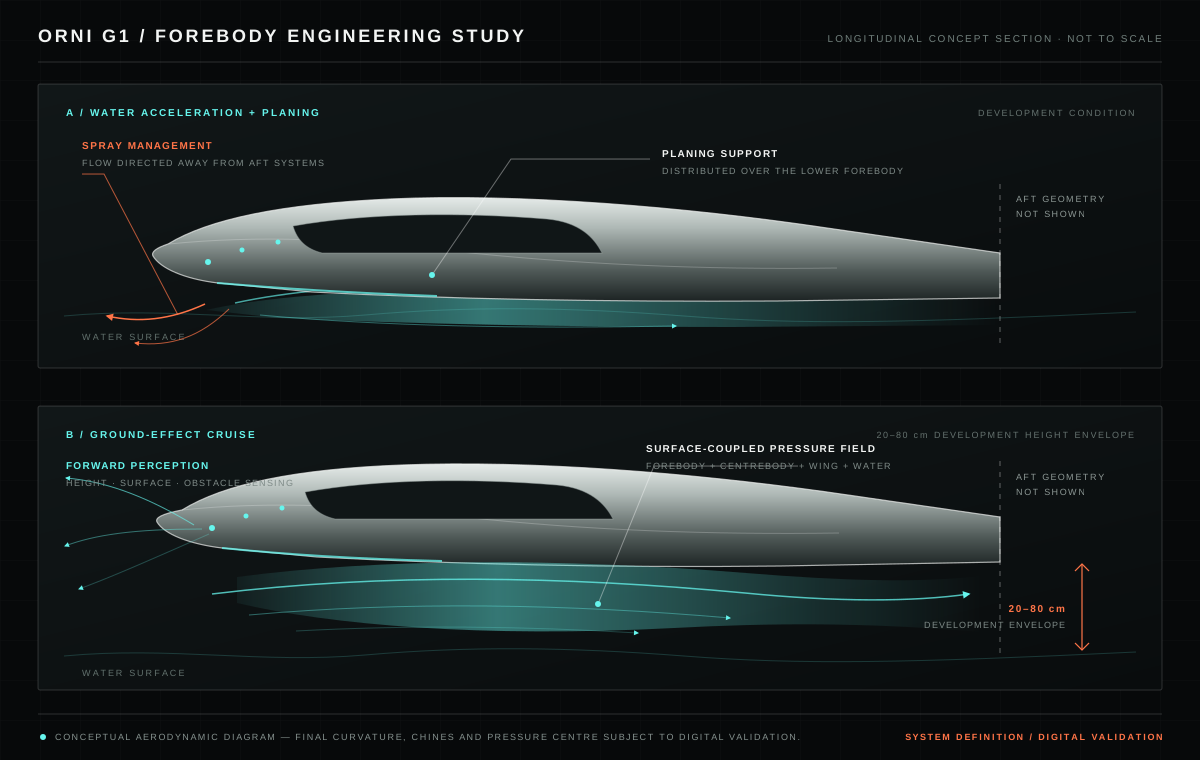
The platypus-inspired forebody is not styling applied after the aerodynamics. It is a functional design direction for the water–air boundary, where low-speed airflow, planing loads, pitch balance, spray control and sensing must be resolved together.

WHY NOT A POINTED FIGHTER-STYLE NOSE?

A slender pointed nose is valuable when high-speed wave-drag and shock-wave management dominate, especially in transonic and supersonic flight. ORNI G1 is being developed for water acceleration, take-off transition and low-altitude ground-effect cruise, so its priorities are fundamentally different.

Engineering diagram of the ORNI G1 forebody showing planing support, spray management and ground-effect airflow

FOREBODY + CENTREBODY + WING + WATER SURFACE

01

BROADER PRESSURE FIELD

A low, wide forebody can distribute pressure over a larger area and blend smoothly into the centrebody and wing. This allows the forward body to contribute to overall aerodynamic loading and pitch balance.

02

CONTROLLED PLANING

The lower surface can be tuned with shallow deadrise, longitudinal curvature, chines and spray-control features to build hydrodynamic support and reduce wetted area as speed increases.

03

SURFACE-COUPLED FLOW

Ground-effect benefit comes from the pressure system created by the nose, centrebody, wing and water surface together. A broad, smoothly blended transition helps those elements work as one system.

04

SPRAY + SENSING

The wide forebody creates room to guide spray away from propulsion and control surfaces while housing distributed height, obstacle and surface-awareness sensors inside a clean radome.

The design premise is not “a blunt nose creates more lift.” It is that a wide, low and smoothly blended forebody allows more of the vehicle to participate in aerodynamic load distribution, hydrodynamic planing, pitch stability and environmental sensing.

Engineering direction only. Final curvature, deadrise, chine geometry, spray behaviour and pressure-centre location are being evaluated through CFD, hydrodynamic analysis and digital models, followed by subscale and full-scale water trials.

BIO-INTELLIGENCE / 04B

The bill senses before the body reacts.

Inspired by the platypus and its electroreception, the broad nose is more than a visual signature. It is conceived as a radar-transparent sensor radome—integrating height, obstacle and surface awareness beneath a clean composite skin.

01

SURFACE PERCEPTION

Radar, LiDAR and ultrasonic sensing concepts map the water immediately ahead.

02

HEIGHT AWARENESS

Continuous low-level ranging supports a protected operating envelope close to the surface.

03

CLEAN INTEGRATION

Sensors disappear inside the structure, preserving aerodynamic flow and the ORNI silhouette.

MODULAR ARCHITECTURE / 05

Built to separate. Engineered to reconnect.

Nose, wings, battery and rear power systems are organised as serviceable modules. Aircraft-grade locating features, load-bearing interfaces and interlocks are being developed for rapid assembly, inspection and trailer transport.

A

SENSOR NOSE

Radome + forward structure

B

COCKPIT CORE

Pilot cell + primary controls

C

WING MODULES

Quick-fit left + right structures

D

ENERGY MODULE

Protected, serviceable battery

E

POWER MODULE

Twin ducted propulsion + tail

Target: removable wing modules within 20 minutes

SAFETY BY DESIGN / 06

Safety is the architecture.

G1 is being defined around a controlled operating envelope—not unrestricted flight. The programme prioritises stable flotation, low-speed water handling, protected transition into ground effect and a recoverable response to system faults.

01

HEIGHT ENVELOPE

Software-limited low-altitude operation with multiple ranging inputs.

02

POSITIVE BUOYANCY

The vehicle remains afloat and towable after propulsion loss.

03

TWIN PROPULSION

Independent electric drive supports redundancy and differential control.

04

REMOTE E-STOP

A supervised test mode can command immediate propulsion isolation.

05

FLIGHT DATA

Attitude, height, power, temperature and vibration recorded for every trial.

06

WATER AWARENESS

Obstacle, spray, crosswind and wave-state inputs shape the operating boundary.

Development begins in controlled water with a safety boat, shore observer and defined emergency procedures.

DEVELOPMENT ROADMAP / 07

Earn every metre.

System Definition and Digital Validation are progressing in parallel. The programme advances only as technical and safety risks are closed—no red risk moves forward.

01

SYSTEM DEFINITION

Freeze requirements, interfaces, risk register and verification plan.

CURRENT
02

DIGITAL VALIDATION

CFD, hydro behaviour, structures and propulsion coordination.

CURRENT
03

FULL-SCALE MVP

Modular prototype, static loads, buoyancy and low-speed taxi.

04

CONTROLLED WATER TRIALS

Progressive speed, transition and unmanned ground-effect validation.

05

G1 EXPERIENCE PROGRAM

Pilot training, maintenance, insurance data and partner operations.

ORNI G1 concept in its Australian Murray River development environmentMILDURA / AUSTRALIA

PARTNER WITH ORNI / 08

Australia is the launch platform.

Mildura and the Murray River place ORNI close to a natural development environment, advanced composites capability and a market ready for new water experiences. The first commercial model is deliberately focused: controlled waters, professional operators and short, repeatable missions.

01

EXPERIENCE

Resorts, tourism and supervised water-sport operations

02

PLATFORM

A modular electric architecture for future two-seat and mission variants

03

ECOSYSTEM

Training, service, telemetry, insurance and local support

Seeking engineering, test-water, investment and strategic operating partners.

CURRENT / SYSTEM DEFINITION + DIGITAL VALIDATION

ORNI / NEXT

Help define the next boundary.

ORNI G1 is currently progressing through System Definition and Digital Validation. We welcome serious conversations with technical partners, controlled-water venues and aligned investors.